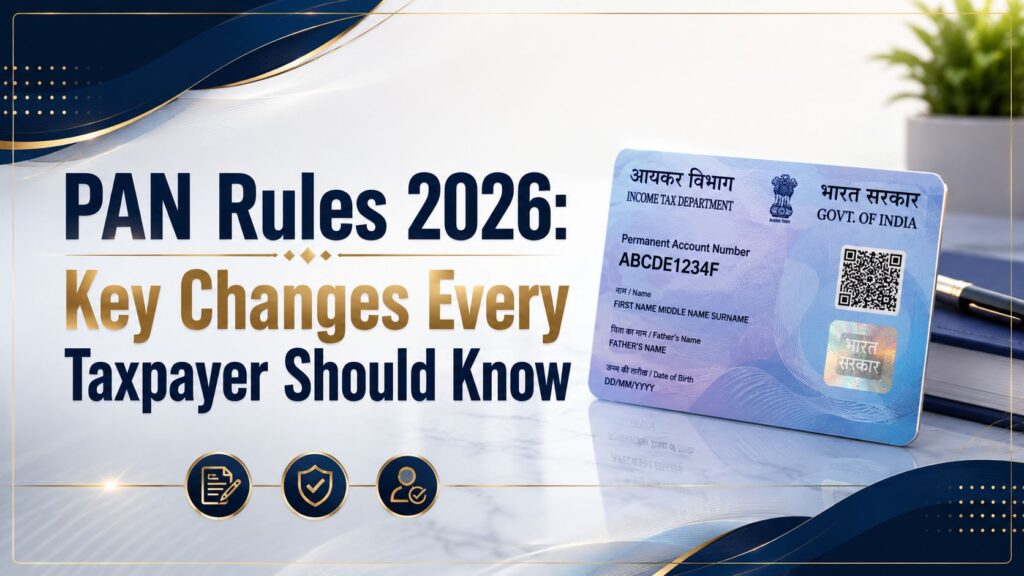
PAN Rules 2026: Key Changes Every Taxpayer Should Know
The Income Tax framework in India has undergone major changes with the introduction of the Income Tax Act, 2025 and Income Tax Rules, 2026. One of the most significant updates relates to PAN (Permanent Account Number) quoting requirements, transaction reporting limits, and compliance procedures.
These changes aim to simplify compliance for genuine taxpayers while increasing monitoring of high-value financial transactions. The government has revised several monetary thresholds, expanded reporting obligations, and replaced Form 60 with the newly introduced Form 97.
Here’s a detailed breakdown of the important PAN Rules 2026 updates and how they may impact individuals, businesses, investors, and property buyers.
What is PAN Quoting?
PAN quoting means providing your PAN number while carrying out specified financial transactions. The Income Tax Department uses PAN to track high-value transactions and ensure transparency in tax reporting.
Under the new rules, several thresholds have been revised upward, providing relief in some areas while tightening compliance in others.
Major PAN Rule Changes in 2026
1. Purchase or Sale of Immovable Property
The threshold for mandatory PAN quoting in property transactions has been increased significantly.
Earlier Rule
PAN was mandatory for property transactions above ₹30 lakh.
New Rule (2026)
The threshold has now been increased to ₹45 lakh.
Additional Expansion
The rules now specifically include:
- Gift deeds
- Joint Development Agreements (JDA)
This means PAN will be compulsory for all eligible property transactions exceeding ₹45 lakh, including gifted property arrangements and development agreements.
Impact
This change provides relief for smaller property transactions while ensuring better reporting for high-value real estate deals.
2. Foreign Exchange Transactions
The government has introduced separate thresholds based on whether PAN is available or not.
New Thresholds
- ₹10 lakh when PAN is available
- ₹5 lakh when PAN is not available
Impact
Individuals without PAN may face stricter limits while conducting foreign exchange transactions, encouraging wider PAN compliance.
3. Cash Deposits in Savings Accounts
Cash transaction monitoring has become more structured under the new rules.
Earlier Rule
PAN was required for cash deposits exceeding ₹50,000 in a single day.
New Rules
- Daily ₹50,000 requirement removed
- Annual threshold increased from ₹2.5 lakh to ₹10 lakh
- Separate monitoring for withdrawals introduced
New Withdrawal Rule
PAN is now mandatory for annual cash withdrawals exceeding ₹10 lakh.
Impact
This offers operational convenience for regular banking users while improving monitoring of large cash movements.
4. Bank Drafts and Pay Orders
New Thresholds
- ₹10 lakh with PAN
- ₹5 lakh without PAN
These revised limits apply to cash payments made for:
- Bank drafts
- Pay orders
- Banker’s cheques
5. RBI Pre-paid Instruments
The revised rules now apply even if instruments are purchased through non-cash methods.
Key Change
The ₹10 lakh threshold is applicable irrespective of the mode of payment.
Impact
Digital purchases are now also covered under reporting requirements.
PAN Quoting Relaxed for Certain Transactions
The government has relaxed PAN requirements in some commonly used areas.
6. Credit and Debit Card Applications
Major Relief
PAN is no longer mandatory for debit card applications.
This reduces documentation requirements for banking customers.
7. Hotel and Restaurant Payments
Earlier Threshold
₹50,000 per transaction
New Threshold
₹1 lakh per transaction
Expanded Coverage
The scope now includes:
- Banquet halls
- Convention centres
- Event managers
Impact
Luxury events and hospitality payments will now fall under wider reporting requirements.
8. Motor Vehicle Transactions
New Rule
PAN is mandatory for sale or purchase of motor vehicles exceeding ₹5 lakh.
Additional Expansion
The rule now includes:
- Eligible two-wheelers
Exclusion
- Tractors are excluded
Impact
The government aims to improve tracking of high-value automobile purchases.
9. Foreign Travel and Foreign Currency
Previously, PAN quoting was separately required for foreign travel packages and foreign currency purchases.
New Position
These are no longer independently covered categories under PAN quoting rules.
This simplifies compliance for travellers.
New Transactions Reportable to Income Tax Department
The Income Tax Department has widened the list of reportable financial activities.
10. Stamp Paper Purchases
Transactions through Stock Holding Corporation of India Limited are now reportable.
Thresholds
- ₹2 lakh with PAN
- ₹1 lakh without PAN
11. Insurance Premium Receipts
Insurance-related payments are now under enhanced reporting.
Thresholds
- ₹5 lakh with PAN
- ₹2.5 lakh without PAN
Impact
Large insurance premium payments will now be closely monitored.
Form 97 Replaces Form 60
One of the most important compliance changes is the replacement of Form 60.
What Was Form 60?
Form 60 was used by individuals who did not possess a PAN but needed to undertake specified financial transactions.
New Rule Under Income Tax Rules, 2026
Rule 159 introduces Form No. 97 in place of Form 60.
Important Restriction
For immovable property transactions exceeding ₹45 lakh:
- Form 97 cannot be used
- PAN becomes mandatory
This means individuals involved in high-value property transactions must obtain PAN compulsorily.
Why These PAN Rule Changes Matter
The PAN Rules 2026 aim to achieve multiple objectives:
1. Better Financial Transparency
The government can track high-value transactions more effectively.
2. Reduced Compliance Burden
Higher thresholds reduce unnecessary paperwork for smaller transactions.
3. Digital Monitoring Expansion
Non-cash and digital transactions are now increasingly covered.
4. Wider Tax Base
The rules encourage more individuals to obtain PAN and become tax-compliant.
Why These PAN Rule Changes Matter
The PAN Rules 2026 aim to achieve multiple objectives:
1. Better Financial Transparency
The government can track high-value transactions more effectively.
2. Reduced Compliance Burden
Higher thresholds reduce unnecessary paperwork for smaller transactions.
3. Digital Monitoring Expansion
Non-cash and digital transactions are now increasingly covered.
4. Wider Tax Base
The rules encourage more individuals to obtain PAN and become tax-compliant.
Who Will Be Most Affected?
These changes are especially important for:
- Property buyers and sellers
- High-value cash transaction users
- Investors
- Foreign travellers
- Insurance policyholders
- Automobile buyers
- Businesses handling large payments
Final Thoughts
The PAN Rules 2026 represent a major shift in India’s financial reporting and compliance framework. While several thresholds have been increased to provide relief to ordinary taxpayers, the government has simultaneously widened reporting coverage for high-value and sensitive transactions.
Taxpayers should carefully review the revised limits and ensure proper PAN compliance to avoid penalties, transaction restrictions, or reporting issues.
Obtaining and linking PAN has become more important than ever, particularly for property transactions, large banking operations, insurance payments, and investment-related activities.
Staying updated with these changes can help individuals and businesses maintain smooth financial compliance under the new Income Tax regime.