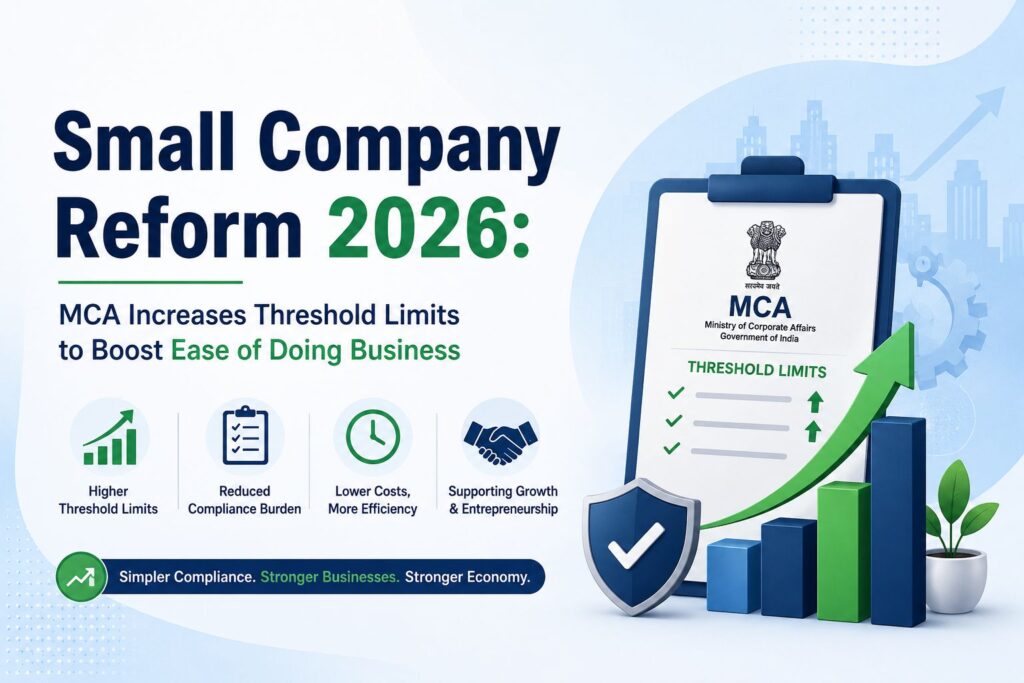
MCA raises threshold limits for small company reform 2026 to boost ease of doing business
India has taken yet another giant step towards making it easier to do business for entrepreneurs and growing businesses. To promote Ease of Doing Business, the Ministry of Corporate Affairs (MCA) has revised the financial thresholds for the definition of Small Company under the provisions of the Companies Act, 2013.
This reform is expected to benefit thousands of private companies across the country by reducing their compliance burden, lowering administrative costs, and enabling them to focus more on business growth rather than regulatory formalities.
In this article, we will explore the latest changes, understand their implications, and discuss how businesses can take advantage of these revised norms.
What is a Small Company Under the Companies Act, 2013?
The concept of a small company was introduced under Section 2(85) of the Companies Act, 2013 to provide regulatory relief to smaller businesses. Companies classified as small companies are entitled to various compliance relaxations compared to other private limited companies.
However, certain companies are excluded from this category, such as:
- Public companies
- Holding companies
- Subsidiary companies
- Companies registered under Section 8 of the Companies Act
- Companies governed by special Acts
MCA’s Revised Definition of Small Company
To further support India’s entrepreneurial ecosystem, the MCA has enhanced the financial limits defining a small company.
Revised Thresholds
| Particulars | Earlier Limit | Revised Limit |
|---|---|---|
| Paid-up Share Capital | Up to ₹4 Crore | Up to ₹10 Crore |
| Turnover | Up to ₹40 Crore | Up to ₹100 Crore |
A company can qualify as a small company if it satisfies both the prescribed conditions regarding paid-up capital and turnover, subject to the exclusions specified under the Act.
Why Did MCA Revise the Thresholds?
The government introduced these changes with multiple objectives:
1. Improving Ease of Doing Business
Reducing unnecessary regulatory hurdles enables businesses to dedicate more time and resources to innovation, expansion, and customer service.
2. Supporting Growing Businesses
Many businesses outgrow the previous thresholds relatively quickly. The revised limits ensure that companies experiencing moderate growth continue to enjoy compliance benefits.
3. Lowering Compliance Costs
Annual filings, meetings, certifications, and procedural requirements often impose substantial costs on smaller enterprises. The reforms help reduce these expenses.
4. Encouraging Formalization
Simplified compliance requirements motivate businesses operating informally to adopt structured corporate forms.
5. Enhancing Competitiveness
Reduced administrative burden allows management teams to focus on strategic decision-making and business development.
Benefits Available to Small Companies
Companies falling within the revised definition may enjoy several compliance relaxations under the Companies Act, 2013.
1. Simplified Annual Return Filing
The annual return of a small company can be signed by:
- A Company Secretary, or
- Where there is no Company Secretary, by a director of the company.
This reduces procedural complexity.
2. Reduced Number of Board Meetings
Small companies are required to hold only:
- One Board Meeting in each half of the calendar year, and
- The gap between two meetings should not be less than 90 days.
This is significantly lower than the general requirement applicable to many companies.
3. Lesser Penalties for Non-Compliance
Under certain provisions of the Companies Act, small companies may be subject to lower penalties compared to larger companies.
This approach recognizes the operational limitations faced by smaller enterprises.
4. Exemption from Cash Flow Statement
While preparing financial statements, eligible small companies are generally not required to include a cash flow statement as part of their financial reporting package.
This simplifies year-end financial preparation.
5. Reduced Reporting Burden
Several disclosures and compliance requirements applicable to larger entities are relaxed for small companies.
This contributes to substantial savings in professional fees and administrative effort.
Impact of the Revised Definition
The increased thresholds are expected to bring a large number of private companies within the ambit of small companies.
Positive Outcomes Include:
- Lower compliance expenditure.
- Reduced dependence on extensive professional certifications.
- Better allocation of resources towards core business functions.
- Enhanced operational flexibility.
- Greater encouragement for startups and family-owned businesses.
The reform aligns with the Government of India’s broader vision of creating a business-friendly regulatory environment.
Who Will Benefit the Most?
The revised norms are particularly beneficial for:
Startups
Growing startups that have achieved moderate success but are not yet large enterprises can continue to avail compliance relaxations.
Family-Owned Businesses
Closely held businesses structured as private limited companies can reduce administrative overheads.
Manufacturing Units
Small and medium-sized manufacturing entities often face significant regulatory costs. The reform offers meaningful relief.
Service-Based Companies
Consulting firms, technology companies, and professional service providers falling within the revised thresholds can also benefit.
Important Points to Remember
Even if a company satisfies the financial thresholds, it will not qualify as a small company if it is:
- A holding company,
- A subsidiary company,
- A Section 8 company, or
- A company governed by any special legislation.
Therefore, businesses should carefully evaluate their eligibility before claiming the associated benefits.
Compliance Strategy for Businesses
With the revised limits in place, companies should undertake the following steps:
Review Eligibility
Assess the company’s paid-up share capital and turnover to determine whether it falls within the revised definition.
Update Internal Compliance Calendars
If the company qualifies as a small company, compliance schedules may require modification.
Consult Professionals
Seeking advice from qualified professionals can help businesses maximize available benefits while maintaining regulatory compliance.
Focus on Growth
The reduced compliance burden provides an opportunity to redirect management attention toward expansion and profitability.
Conclusion
The MCA’s decision to revise the definition of a small company marks an important milestone in India’s journey toward improving the business ecosystem. By increasing the thresholds to ₹10 crore paid-up share capital and ₹100 crore turnover, the government has extended regulatory relief to a much larger segment of businesses.
For eligible companies, this translates into simplified compliance procedures, reduced filing obligations, lower costs, and improved operational efficiency.
Businesses should proactively evaluate their status under the revised framework and leverage these benefits to strengthen their long-term growth strategies.
As India continues to promote entrepreneurship and economic development, such reforms demonstrate the government’s commitment to creating a more supportive environment for businesses of all sizes.